According to THE MEDIA RESEARCH BUREAU, Washington D. C., the name of Bertrand or Bertram is said to have been of French origin, meaning “a stately hero”. It is found on ancient records in various forms: in French – Bertran/Bertrand/ Bertrant/ Bertrande/ Bertrandt/ Batraw/ Bertrade. In English – Bertram/ Barton. Spanish – Beltran. Italian – Bertrano. Latin – Bertrannus.
Other sources claim that the name, Bertrand, is the Medieval French form of Bertram. Bertram is an Old German name derived from brecht-ram meaning “renowned for strength”, also, “smart raven” or “bright raven” and even “brilliant raven: illustrious”. Bertrand and Bertram are the forms most generally accepted in America today. The name is found in practically every State of the Union.
Bertrand family members have been noted for their energy, industry, integrity, piety, perseverance, fortitude, patience, initiative and resourcefulness. A few saints that are not widely known bear this name.
It is said that the Bertran and Bertrand famille was anciently settled in Poitou and Bourbonnais, in France and that one branch remained in that district, while another went into England using the Bertram name.
Originally, the name Bertrand, was the only name of an individual. With an increase in world population, this resulted with many individuals with the same name. Thus, Bertrand became the surname and Christian names began to appear to distinguish the various Bertrand family members.
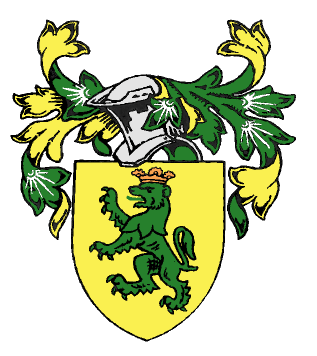
Of great interest today and of ancient origin, is the numerous coat-of-arms awarded to various individuals of the Bertrand family for heraldry, valor and gallantry in the battles of yore. One may find many different Coat-of-Arms/Armories/Emblems/Blazons for the Bertrand name, depending on which commercial company of historical memorabilia contacted (and, may change from year to year -never the same). The committee organized to administer to the Bertrand Famille, Congre Mondial 99, to be held in August 1999, Crowley, Louisiana, reviewed nearly one hundred of these symbols and found over eighty had one thing in common, the Griffin.
The Griffin is the Heraldic symbol of Valor, Vigilance and Loyalty and Truth. Usually, the Griffin is mounted on a plaque of Armor, Flourishes and Crest – and, perhaps it may include a motto or/and surname. The Griffin alone on a plaque was selected to represent all the Bertrands coming together for this historic event and blood red was the color used to represent bonding and unity of the great Family of Bertrand.
Velia Bertrand / 4 May 2003
THE BERTRAND MOTTO
According to the Dictionary of French Biography, the Bertrand family name traces its origins back to the ancient territories of France and Normandy between the XIth and XIIth centuries. The Bertrand motto is “Courage and Fidelity, Honour and Diligence”, according to the supplement to the Tausin Dictionary of Historical Heraldic Devices. – Unknown / Association of the Descendants of Paul Bertrand dit Saint-Arnaud
THE BERTRAND SAINTS
BERTRAND (Also known as Bertichramnus) Memorial 30 June
Profile Educated and ordained in Paris by Saint Germanus of Paris. Worked at the cathedral school at Paris, and archdeacon of the city. Bishop of Le mans in 587. Noted for his generosity, personally and from his position, to the poor. Founded a monastery, hospice, and church in his diocese. Known for his farming skills, excellent vineyards, and quality wine. Forced to take sides in factional disputes of the day, he was repeatedly driven into exile. Reinstated permanently to his see by King Clotaire II in 605.
- Born c.553 at Autun, France
- Died 30 June 623 of natural causes
- Canonized Pre-Congregation
BERTRAND of Saint Quentin Memorial 24 January
Profile Benedictine monk. Friend of Saint Bertinus. Aide to Saint Omer. Missionary in northern France and Flanders, Belgium. Abbot of Saint Quentin abbey.
- Died 7th century of natural causes
- Canonized Pre-Congregation
BERTRAND of Comminges Memorial 16 October
Profile Son of a military officer. His family exepected a military life for Bertrand, but he was drawn to religion, joined the canons of Toulouse, and became an archdeacon. Bishop of Comminges, France c.1075, a position he served for nearly 50 years; this area is part of the modern diocese of Toulouse. Reformed the clergy, inforced their discipline, and placed the cathedral canons under Augustinian Rule. Worked in the Synod of Poitiers in 1100; this synod excommunicated King Philip I, and were stoned by the public for their trouble. Helped preside at the consecration of the cemetery of Saint Mary at Auch during which some embittered monks from Saint Orens tried to burn down the church. Once during a sermon at Val d”Azun, Bertrand was particularly forceful in taking the faithful to task for their sins. A near riot broke out, which Bertrand calmed before serious problems occurred. To make up for the disturbance, the local leaders agreed to provide free butter to Comminges every year during the week after Pentecost, a custom that continued until stopped by the French Revolution nearly 700 years later.
- Born 11th century France
- Died 1123 of natural causes
- Canonized 1309 by Pope Alexander III
BERTRAND (Also known as Bertrichramnus) Memorial 6 June
Profile Priest. Dean of the cathedral chapter of Angouleme, France. Bishop of Aquilela, Italy. Died defending the rights of the Church.
- Born 1260 near Cahors, France
- Died martyred in 1350